- By Admin
- 07 April, 2026
- 8 min Read
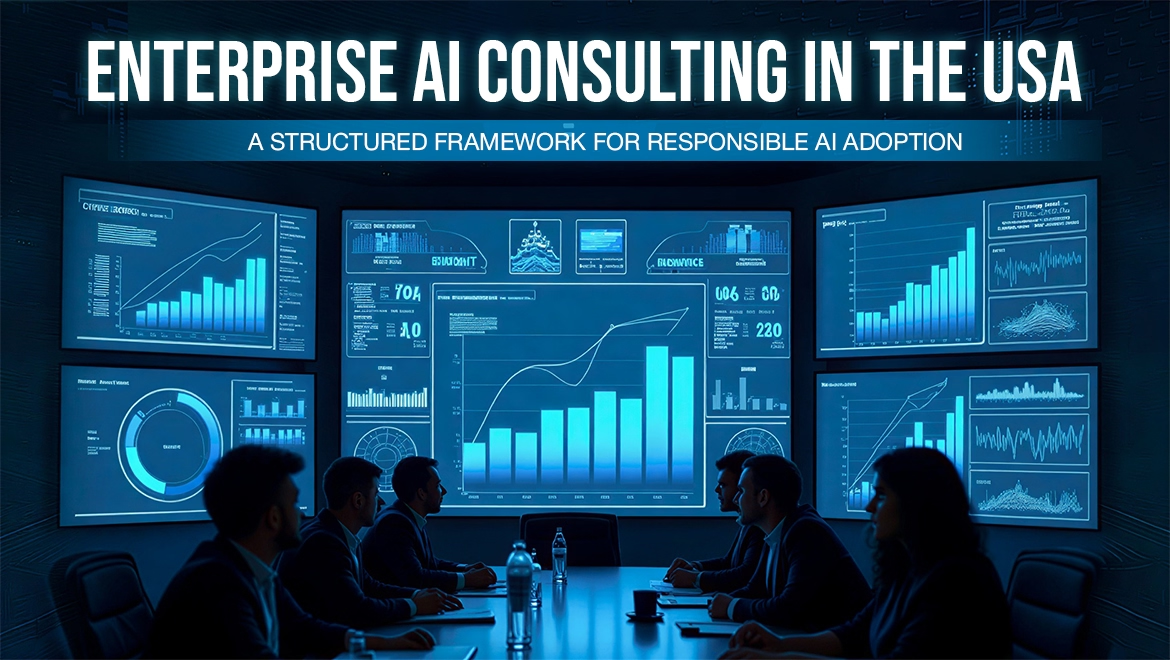
Enterprise AI Consulting in the USA: A Structured Framework for Responsible AI Adoption
Artificial intelligence is no longer a future option for US business automation. It is a baseline requirement for staying competitive. According to the McKinsey State of AI 2024 report, around 72% of companies have implemented AI in one or more business functions, up from approximately 50% just two years prior.
A global PwC study forecasts AI will add approximately $15.7 trillion to the world economy by 2030, with North America among the primary beneficiaries.
For C-suite leaders, the challenge is not whether to use AI but how to use it responsibly and at scale. AI consulting companies in USA deliver what ad-hoc adoption cannot: a disciplined, phase-by-phase framework that moves organizations from readiness to measurable results.
Choosing the right ai consulting services USA partner is one of the most consequential strategic decisions an enterprise can make today.
AI Readiness Assessment: The Starting Point for Every Engagement with Top AI Consulting Firms USA
The most common enterprise AI failure starts before a model is built-organisations launch implementation without first establishing whether they are ready. An AI readiness assessment is a structured diagnostic that evaluates four dimensions:
- Strategic Fit: Which business problems are addressable through AI versus process re-engineering?
- Data Availability and Quality: Whether data needed to train and run AI models exists and meets quality thresholds.
- Technology Infrastructure: Whether cloud, compute, and integration architecture support AI workloads at scale
- Organizational Capability: Whether leadership and functional teams have the skills and change readiness to adopt AI.
The AI consulting engagement process assessment to implementation USA model Aryabh Consulting follows is sequential: readiness first, architecture second, and deployment only when both foundations are confirmed solid. This diagnostic phase is mandatory before any vendor selection or budget commitment is made.
AI Governance: Why They Define Leading Ethical AI Consultancies USA
AI governance is the structured management of how AI systems are built, deployed, and overseen, setting the compliance standards, which ensure interpretability, reliability, and accountability. In US financial services, healthcare, and energy sectors, governance has become central to regulatory risk management.
What separates leading ethical ai consultancies USA from the rest is not model sophistication but the rigor of their governance frameworks. An effective enterprise governance model includes:
- AI Use Policy: What types of uses are allowed, which ones require raising a concern, and which ones are totally unsuitable?
- Accountability Structures: Establishing clear ownership for every AI system, including third-party models.
- Bias and Fairness Controls: Conducting regular output audits, particularly for customer-facing decisions.
- Explainability Standards: Ensuring AI systems making high-stakes decisions provide auditable reasoning.
- Incident Response: Building clear protocols for identifying and containing AI errors before they escalate.
According to Diligent's NIST alignment analysis, private sector AI investment in the US exceeded $100 billion in 2024, which is more than 10 times the amount of any other country.
Top AI consulting firms USA ensure companies get a governance structure fine-tuned to the regulatory risks of their specific sector, built in from the start, not bolted on after deployment.
Data Infrastructure Maturity: Where Most AI Initiatives Break Down
AI models are only as reliable as the data they learn from. In most US enterprises, data is fragmented across dozens of systems, inconsistently labelled, and governed by policies predating machine learning. That gap is where AI initiatives break down.
Structured AI consulting services USA engagements address data maturity through four priorities:
- Data Inventory and Lineage Mapping: Identifying what data you have and how it flows through the system.
- Quality Assessment: This means identifying the aspects affecting model performance negatively.
- Pipeline Architecture: Building infrastructure to serve AI models in both batch and real-time modes.
- Governance Layer: Implementing data classification and access controls aligned to both artificial intelligence and regulatory requirements.
Organizations that invest in data maturity before deployment consistently outperform those that attempt to fix quality issues after launch, a reality well understood by leading ethical AI consultancies USA.
Risk Management and Compliance: Building AI That Regulated Industries Can Trust
For financial institutions, healthcare systems, and insurers, AI risk is balance-sheet risk, regulatory risk, and reputational risk combined. The most trusted consulting firms AI transformation financial institutions USA share one standard: compliance-by-design, not compliance-by-retrofit. Responsible AI risk management covers four categories:
- Model Risk: Inaccurate or biased outputs are managed through validation and ongoing monitoring.
- Data Risk: Training data errors or privacy violations are managed through governance controls.
- Operational Risk: System failures or misuse are managed through access controls and incident response.
- Regulatory Risk: Violations of ECOA, FCRA, or HIPAA managed through compliance-by-design architecture.
Workforce Enablement: Why AI Transformation Is Also a People Challenge
Technology accounts for only part of why AI transformations succeed. The other part is whether the people using and governing AI systems have the knowledge to do so effectively.
Aryabh Consulting's AI consultants training services USA programs rest on one principle: AI should elevate human capability, not replace human judgment. Workforce enablement means:
- Executive AI Literacy: Equipping C-suite leaders to ask relevant questions about the risk and return of AI.
- Functional Team Training: Raising AI skills among finance operations HR, and customer service teams.
- Technical Upskilling: Training MLOps and responsible AI competencies within internal data science teams.
- Change Management: Embedding AI into daily workflows rather than layering it on top of existing processes.
Frequently Asked Questions
1. What distinguishes structured AI consulting from ad-hoc adoption?
A structured framework begins with a readiness assessment before implementation. It ties every initiative to a defined outcome, addresses data and governance upfront, and designs for scale. Ad-hoc adoption produces isolated pilots that rarely reach production without rework.
2. How do top AI consultancy firms in the USA approach governance for regulated industries?
In regulated sectors, governance is a compliance-by-architecture commitment. Explainability standards, audit trails, and NIST AI RMF alignment are embedded into system design from day one.
3. Which features of AI architecture make it enterprise-scalable?
Modularity, API-first integration, cloud-native design, and MLOps automation enable architecture to scale to new use cases without any full rebuilds, protecting the AI investment as needs keep evolving!
4. What are the ways Aryabh Consulting help AI adoption outside of implementation?
Aryabh Consulting, one of the top ai consulting firms of USA, helps Through governance reviews, post-deployment monitoring, and constant optimization. AI systems degrade as data distributions shift. Sustained engagement is what distinguishes a working pilot from long-lasting enterprise impact and value.