- By Admin
- 08 September, 2026
- 7 min Read
Software as a Medical Device (SaMD). What FDA Classification Means for Your Build Timeline
If you are building healthcare software that touches diagnosis, treatment, or patient monitoring, one decision shapes your entire roadmap before a single line of code matters. That decision is FDA classification.
Most founders and product teams treat FDA classification as a legal formality they will "figure out later." That is a costly mistake. The classification your product falls under determines your testing requirements, your documentation load, your clinical evidence needs, and often your launch date by six months to two years. Get it wrong early and you rebuild later. Get it right early and you build once.
At ACI, we have guided healthcare software teams through this exact process for years. We know the regulations because we live inside them, and we know the software because we build it. This gives us a rare vantage point most development shops do not have. Below we break down what FDA classification actually means, the risks of underestimating it, and the factors that will make or break your timeline.
What Is Software as a Medical Device
Software as a Medical Device, or SaMD, is software intended for one or more medical purposes that performs these purposes without being part of a hardware medical device. Think diagnostic apps, AI powered imaging tools, clinical decision support software, and remote patient monitoring platforms.
Not every piece of healthcare software qualifies as SaMD. A scheduling app for a clinic is not regulated the same way as software that interprets an EKG. The line between "health adjacent" and "medical device" is where a lot of teams get tripped up, and it is exactly where FDA classification enters the picture.
Why FDA Classification Comes First
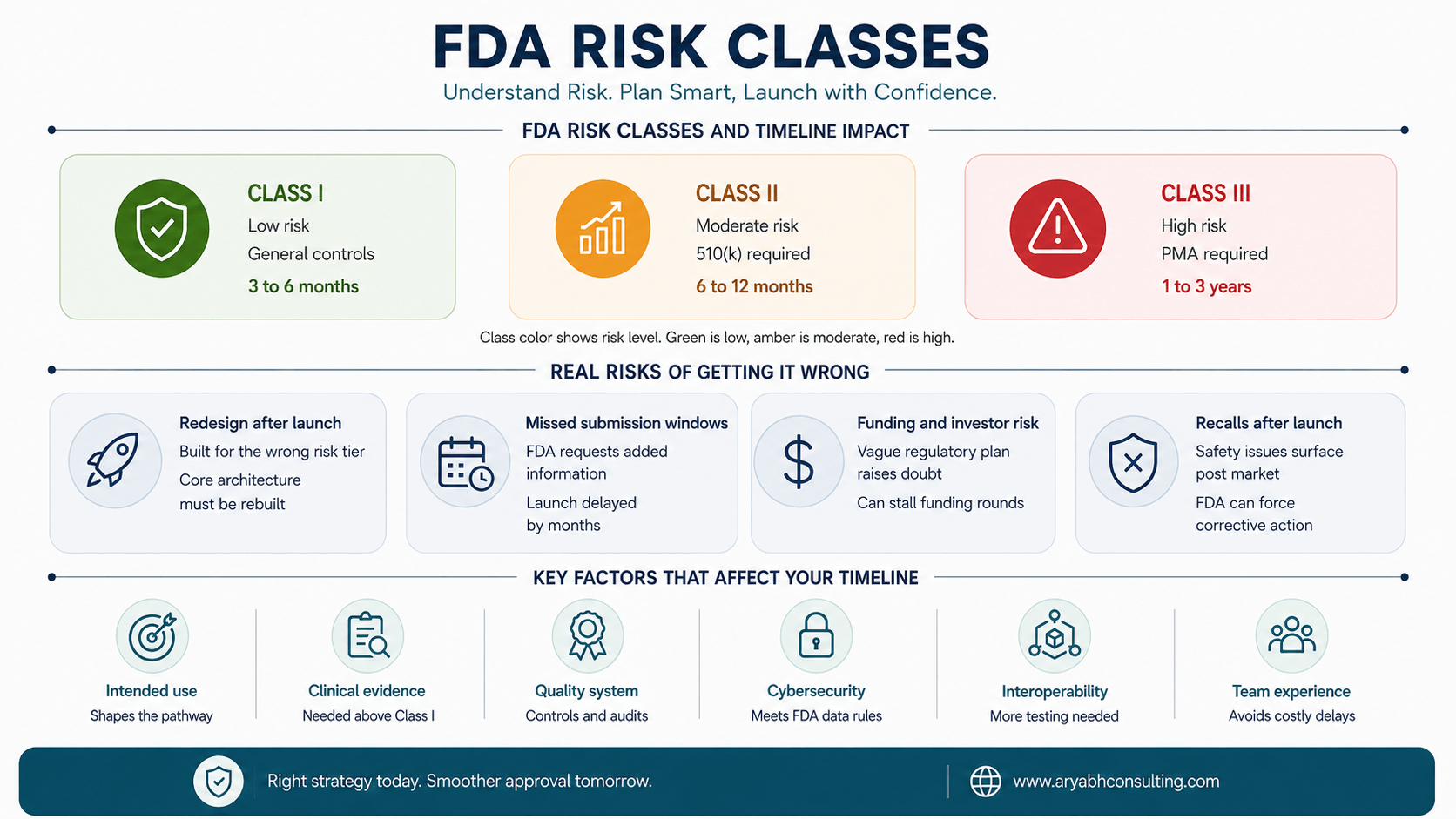
FDA classification places your product into Class I, Class II, or Class III based on the risk it poses to the patient.
- Class I covers low risk devices with general controls. Think basic tracking or wellness tools.
- Class II covers moderate risk devices that usually require a 510(k) submission, showing your product is substantially equivalent to an already cleared device.
- Class III covers high risk devices, often requiring Premarket Approval, the most rigorous and lengthy pathway the FDA offers.
Your classification is not a checkbox you tick after development. It is the foundation your entire build plan sits on. The class determines what evidence you need, what testing you must run, what documentation you must produce, and how the FDA will review your submission. Skip this step or guess at it, and you are building on sand.
The Real Risks of Getting FDA Classification Wrong
Teams that treat FDA classification as an afterthought tend to run into the same problems.
- Redesign after the fact. If your software was built assuming Class I requirements but the FDA determines it belongs in Class II, you may need to add features like audit trails, risk documentation, or clinical validation that were never part of your original architecture. That is not a small patch. That is often a rebuild.
- Missed submission windows. The FDA does not work on your schedule. A submission returned with additional information requests can push your launch back by months. Teams that did not plan documentation alongside development end up scrambling to produce evidence that should have existed from day one.
- Funding and investor risk. Investors and partners want to see a realistic regulatory pathway, not a vague promise that "we'll handle FDA stuff later." Misjudging your classification early can shake confidence and stall a raise.
- Recalls and post market consequences. The FDA does not only enforce rules before launch. Look at how seriously the agency treats consumer product safety even outside medical devices. The FDA deodorant recall in recent years is a good reminder that the agency moves fast and publicly when safety concerns surface, regardless of product category. Medical software carries even higher stakes, because errors can directly affect patient outcomes. A rushed or poorly classified product that reaches market can face corrective action, forced updates, or in serious cases, a full recall.
None of these risks are hypothetical. They happen regularly to teams that treat regulatory strategy as separate from healthcare software development instead of part of the same process.
Key Factors That Impact Your Build Timeline
Once your FDA classification is clear, several factors decide how long your build will actually take.
- Intended use statement. How you define what your software does and who it is for directly shapes your regulatory pathway. A vague or overly broad intended use invites more scrutiny and a longer review.
- Level of clinical evidence required. Class II and Class III devices often need clinical validation data. Planning this early, rather than bolting it on after the software is "done," saves months.
- Quality management system. The FDA expects a documented quality system covering design controls, risk management, and change tracking. Building this alongside your software, not after, keeps your timeline realistic.
- Cybersecurity and data requirements. Medical Device Software must meet strict standards for data integrity and cybersecurity under FDA guidance. Retrofitting security architecture late in development is one of the most common causes of delay.
- Interoperability with existing health systems. If your software needs to integrate with EHR platforms or hospital systems, that adds testing cycles and validation steps that should be mapped from the start.
- Team experience with FDA pathways. Development teams that have never worked through an FDA submission tend to underestimate documentation and testing time by a wide margin. Working with a partner who has been through this before removes a lot of guesswork.
Why ACI
We built our process around one idea. Regulatory strategy and software development should never be separate tracks that collide at the end. At ACI, our teams plan FDA classification requirements into your architecture from the first sprint, not after a beta version is already built. We have worked across Class I, Class II, and Class III products, and we understand where teams typically lose time, money, and momentum.
Healthcare software development is not just about writing clean code. It is about writing code that can survive an FDA review, hold up under audit, and protect patients once it is live. That is the standard we build to.
Final Thought
FDA classification is not paperwork you handle after the product works. It is the framework that decides how the product gets built in the first place. Teams that plan around it early move faster, spend less, and launch with fewer surprises.
If you are early in planning a SaMD product and want a clear read on where your software likely falls and what that means for your timeline, our team at ACI is glad to talk it through with you.