The Rise of Telemedicine Platforms The Rise of Telemedicine Platforms
Artificial Intelligence
  • By ACI
  • 28 January, 2026
  • 11 min Read

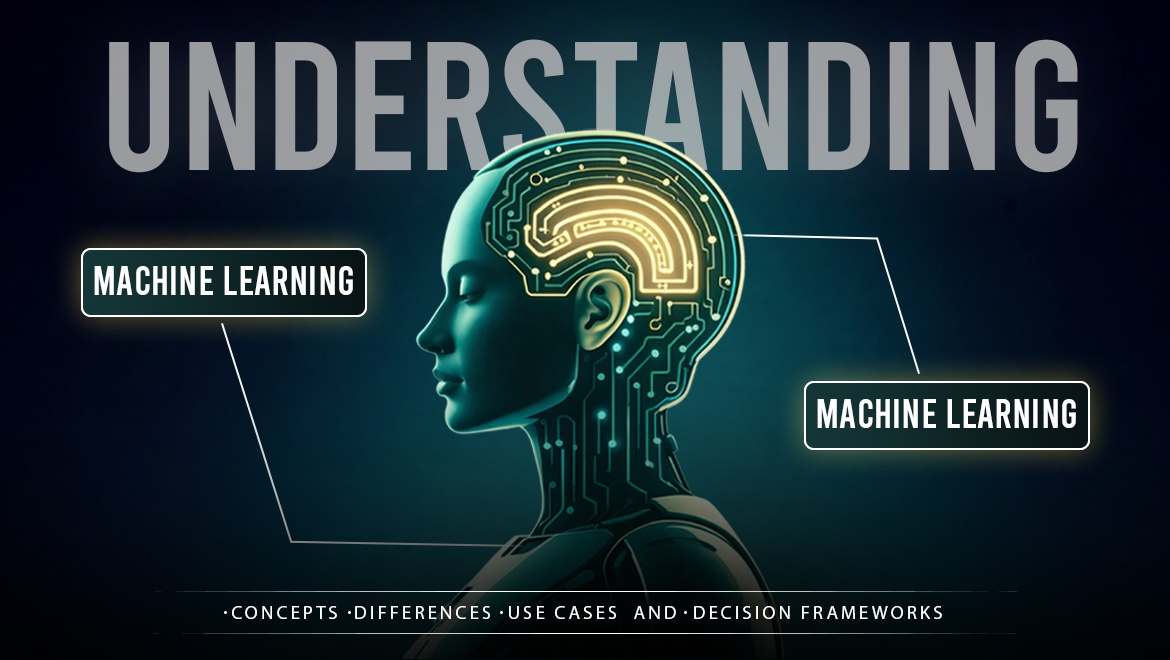
Understanding Machine Learning vs Generative AI - Concepts, Differences, Use Cases, and Decision Frameworks

Artificial Intelligence has moved from experimental technology to a core business capability. Yet even as adoption increases, confusion persists around key terms such as Artificial Intelligence, Machine Learning, Predictive AI, and Generative AI. These concepts are often used interchangeably, despite serving very different purposes in enterprise systems.

This article provides a clear, structured explanation of Machine Learning and Generative AI, how they relate to each other, where they differ, and how organizations should decide between them. The goal is not to promote tools, but to help enterprise leaders, mid market decision makers, and technical teams make informed architectural and investment decisions.

What Is Artificial Intelligence?

Artificial Intelligence refers to computer systems designed to perform tasks that typically require human intelligence. These tasks include reasoning, learning, pattern recognition, language understanding, and decision making.

In enterprise environments, AI is not a single system. It is a collection of techniques and models embedded into software, workflows, and decision engines. Machine Learning and Generative AI are two important subsets within this broader AI ecosystem.

A useful way to understand AI is as the umbrella category. Machine Learning focuses on learning patterns from data. Generative AI focuses on producing new outputs such as text, images, code, or synthetic data. Both are forms of AI, but they solve different problems.

Is Machine Learning a Part of AI?

Yes. Machine Learning is a subset of Artificial Intelligence.

Machine Learning enables systems to improve performance by learning from data rather than following explicitly programmed rules. Most production AI systems used today in enterprises rely on Machine Learning, even if they are not labeled as AI products.

Examples include fraud detection systems, recommendation engines, credit risk models, and demand forecasting platforms.

What Is Machine Learning?

Machine Learning is a discipline within AI that focuses on building models capable of identifying patterns in historical data and using those patterns to make predictions or decisions.

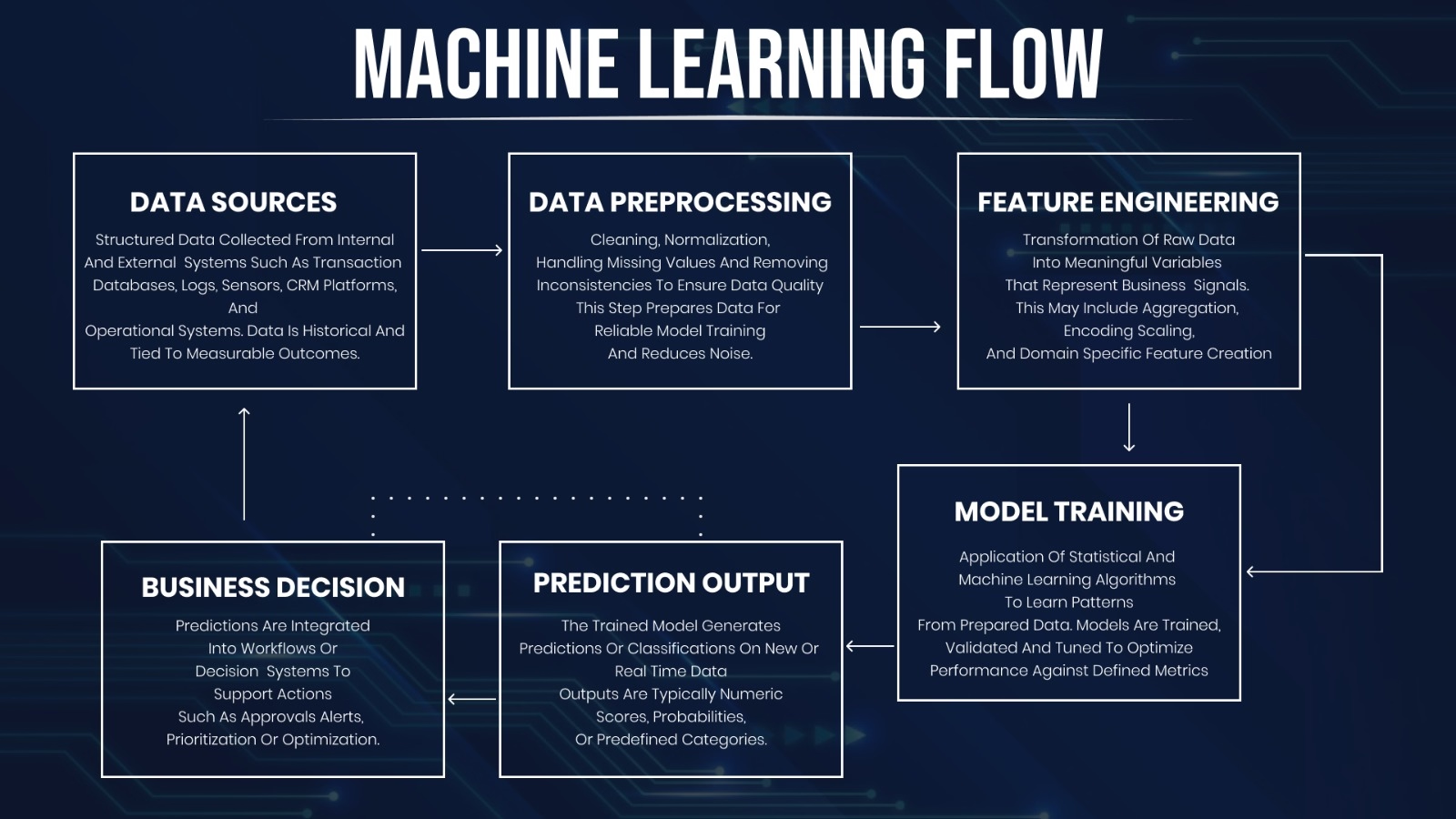
At a high level, Machine Learning systems work through four steps:

  • Data collection from historical or real time sources
  • Feature extraction and preparation
  • Model training using statistical and mathematical techniques
  • Inference where the trained model produces outputs on new data

Types of Machine Learning

  • Supervised learning uses labeled data to predict known outcomes. Common use cases include classification and regression.
  • Unsupervised learning identifies patterns or groupings in unlabeled data. This is often used for clustering or anomaly detection.
  • Reinforcement learning optimizes decisions through feedback and rewards. It is commonly applied in control systems and optimization problems.

Common Machine Learning Use Cases

Machine Learning is well suited for problems where historical data exists and outcomes are measurable.

Typical enterprise applications include demand forecasting, fraud detection, predictive maintenance, risk scoring, customer segmentation, and process optimization.

These systems are predictive in nature. They do not create new content. They estimate probabilities, trends, or classifications based on past data.
What Is Generative AI?

Generative AI refers to a class of AI systems designed to generate new outputs rather than predict predefined outcomes. These outputs may include text, images, audio, code, structured documents, or synthetic data.

Generative AI models learn the underlying structure of data and use that understanding to create new instances that resemble the original data without copying it.

Unlike traditional Machine Learning systems, Generative AI produces open ended outputs. The results are not limited to predefined categories or numeric predictions.

How Generative AI Works at a Conceptual Level?

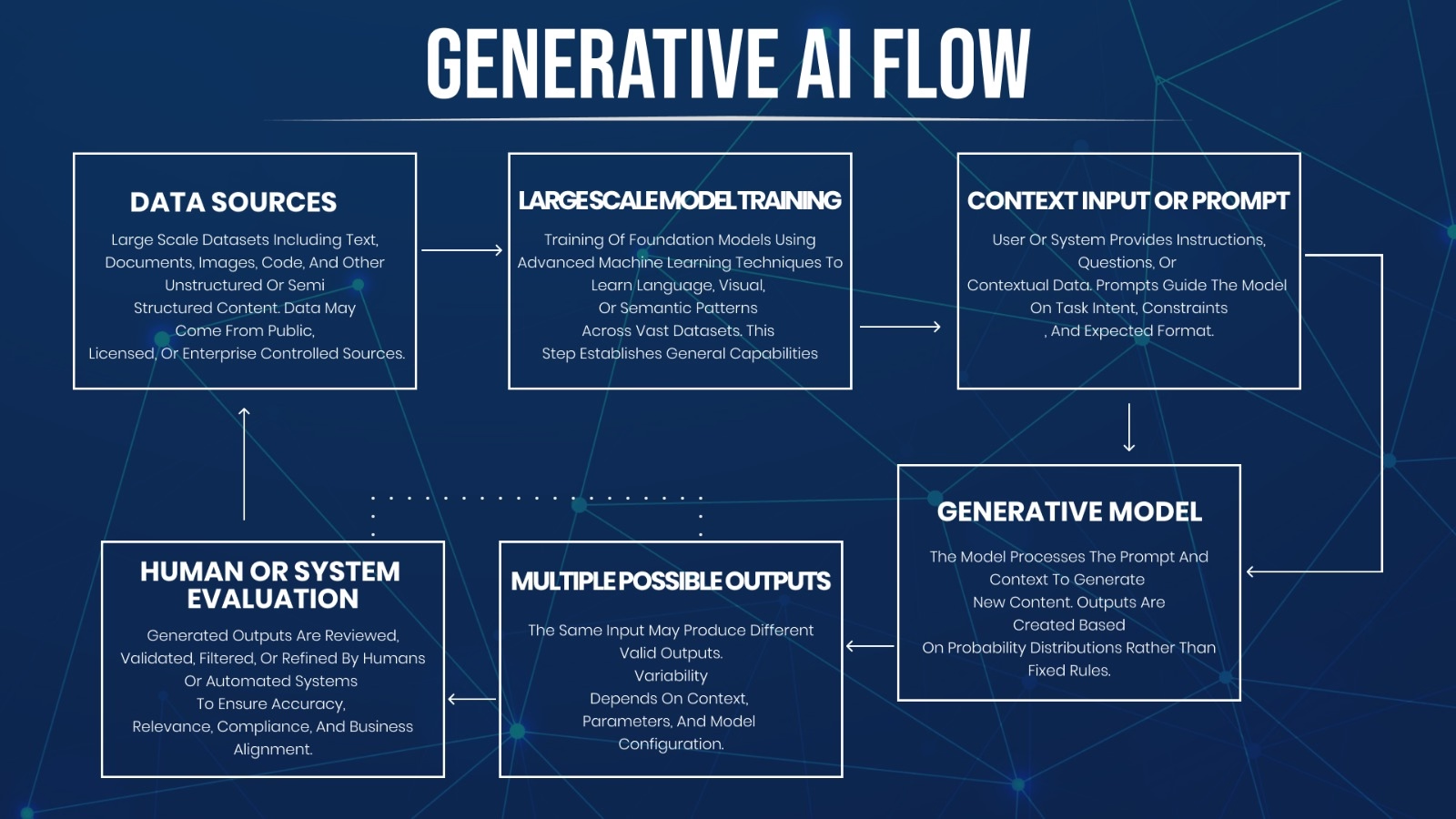
Generative AI systems are typically built on large scale Machine Learning models trained on extensive datasets. These models learn language patterns, semantic relationships, or visual structures. While the underlying technology is complex, the practical distinction is simple. Machine Learning predicts. Generative AI creates.

Generative AI Examples in Business

Generative AI is increasingly used in knowledge work and creative tasks.

Examples include content generation for reports and documentation, conversational assistants for internal knowledge access, code generation and review support, design prototyping, and synthetic data generation for testing and training.

For a deeper look at how generative systems differ at the model level, you may find this comparison useful on Open AI Vs Generative AI by Aryabh Consulting inc.
Is ChatGPT Machine Learning or Generative AI?

ChatGPT is a Generative AI system.

It is built using Machine Learning techniques, but its primary function is generative. It produces human like text responses based on context rather than predicting a fixed output. This distinction matters because it highlights an important relationship. Generative AI relies on Machine Learning, but not all Machine Learning systems are generative.

Predictive AI vs Generative AI

Predictive AI and Generative AI serve different enterprise needs.

  • Predictive AI focuses on forecasting outcomes based on historical data. It answers questions such as what is likely to happen next or how likely an event is.
  • Generative AI focuses on producing new content or solutions. It answers questions such as how something can be written, designed, summarized, or explained.
  • Predictive AI is often easier to validate because outputs can be compared to known outcomes. Generative AI requires stronger governance because outputs may vary and are not always deterministic.

Generative AI vs AI as a Whole

Generative AI is not separate from Artificial Intelligence. It is a specialized capability within AI.

AI includes rule based systems, Machine Learning models, optimization algorithms, and generative systems. Generative AI represents a shift toward systems that support creativity, knowledge synthesis, and unstructured problem solving.

Understanding this hierarchy helps organizations avoid tool driven decisions and focus instead on system design and business outcomes.

Key Differences Between Machine Learning and Generative AI

Aspect Machine Learning Generative AI
Primary goal Predict or classify Create new outputs
Output type Numeric or categorical Text, images, code, media
Determinism Mostly deterministic Probabilistic and variable
Data dependency Structured historical data Large scale structured and unstructured data
Validation Easier to measure accuracy Requires human and contextual evaluation
Enterprise risk Lower Higher without governance
Typical use cases Forecasting, detection, optimization Content, assistance, synthesis

This distinction is critical for enterprise planning. Applying Generative AI where predictive systems are sufficient increases cost and complexity without added value. Applying predictive systems where creative synthesis is needed limits impact.

Relationship Between Machine Learning and Generative AI

Machine Learning forms the foundation of Generative AI.

Generative AI systems are trained using advanced Machine Learning techniques. Without data pipelines, model training processes, and evaluation frameworks, Generative AI cannot function effectively.

From an architectural perspective, organizations that struggle with Machine Learning maturity often face challenges when attempting to adopt Generative AI at scale.

This is why AI transformation should focus on capability building rather than tool adoption. For a broader perspective on how AI systems influence society and enterprise decision making, refer to How Artificial Intelligence Is Reshaping Our Lives Opportunities

Common Generative AI Tools and Capability Categories

Rather than focusing on specific vendors, it is more useful to think in terms of capability classes.

  • Text generation systems support documentation, reporting, and communication tasks.
  • Code generation systems assist with development acceleration and quality control.
  • Image and media generation systems support design and visualization workflows.
  • Enterprise knowledge assistants integrate with internal data sources to provide contextual answers.

Selecting tools without understanding these categories often leads to fragmented systems and governance gaps. A structured evaluation process is essential.

Decision Framework for Businesses

Choosing between Machine Learning and Generative AI requires a clear understanding of the problem being solved.

  • If the goal is prediction or optimization, Machine Learning is often sufficient.
  • If the goal is creation or synthesis, Generative AI may be appropriate.
  • If regulatory risk is high, start with controlled Machine Learning systems.
  • If knowledge work dominates the workflow, Generative AI can deliver productivity gains.
  • If data quality is poor, both approaches require foundational work before deployment.

Enterprises increasingly deploy hybrid systems where Machine Learning handles prediction and Generative AI handles explanation, reporting, or interaction layers.

For teams evaluating research oriented AI tools, this comparison on Gemini Vs Chatgpt vs Perplexity may be relevant

Frequently Asked Questions

1. What is the main difference between Machine Learning and Generative AI?

Machine Learning focuses on learning patterns from historical data to make predictions or classifications. Generative AI focuses on creating new content such as text, images, or code based on learned patterns. Machine Learning predicts outcomes. Generative AI generates outputs.

2. Is Generative AI a type of Artificial Intelligence?

Yes. Generative AI is a subset of Artificial Intelligence. It belongs under the broader AI category, just like Machine Learning. Generative AI systems use Machine Learning techniques but are designed specifically for content and knowledge generation.

3. Is Machine Learning part of Generative AI?

Machine Learning is not part of Generative AI, but Generative AI depends on Machine Learning. Generative AI systems are built using advanced Machine Learning models. Without Machine Learning, Generative AI cannot function.

4. Is ChatGPT Machine Learning or Generative AI?

ChatGPT is a Generative AI system. It is built using Machine Learning methods, but its primary function is to generate human like text responses rather than predict predefined outcomes.

5. What is Predictive AI and how is it different from Generative AI?

Predictive AI uses historical data to forecast outcomes such as risk, demand, or behavior. Generative AI creates new content such as reports, summaries, designs, or code. Predictive AI focuses on accuracy and probability. Generative AI focuses on creativity and synthesis.

6. Which is better for enterprises Machine Learning or Generative AI?

Neither is universally better. Machine Learning is better for forecasting, detection, and optimization. Generative AI is better for content creation, knowledge assistance, and unstructured problem solving. Most enterprises benefit from using both in a controlled and well governed architecture.

Final Perspective and the Role of AI Consulting

Machine Learning and Generative AI are not competing technologies. They are complementary capabilities within a broader AI strategy. Organizations that treat them as interchangeable often experience limited results or governance challenges.

Effective AI adoption requires clarity on use cases, strong data foundations, responsible design, and alignment with business objectives.

Aryabh Consulting Inc. works with enterprises and mid size organizations to design and implement AI systems that are practical, scalable, and aligned with real business needs. This includes evaluating where Machine Learning is sufficient, where Generative AI adds value, and how both can be integrated into secure and compliant enterprise architectures.

This article is intended solely as a technical overview based on our insights and understanding of current technology trends. It does not promote, endorse, or represent any specific company, product, or individual. The content is purely informational and reflects our independent perspective on the subject.
1

Related Blogs

From Automation to Innovation: Multi-Agent AI in 2025
Artificial Intelligence

From Automation to Innovation: Multi-Agent AI in 2025

By Admin 5 min Read

The concept of a multi-agent AI system is not entirely new! Since the 1980s, technologies have explored the idea of creating an artificially intelligent, single software entity. However, early models had certain limitations because of insufficient computing power, underdeveloped algorithms, and a lack of labeled data. Fast forward to 2025, and today a rapid advancement in generative AI combined with the natural language capabilities of LLM (Large Language Models) has redefined this vision. While not the single AI entity originally envisioned, multi-agent AI is an advanced evolution of that idea. These advanced systems consist of intelligent, intertwined AI tools, including large language models, smoothly integrated into software ecosystems. By enabling AI agents—each functioning as an LLM-powered application, function, or module—to interact and collaborate, multi-agent AI unleashes new levels of efficiency, automation, and decision-making. Unveiling a New Dawn in Human-Computer Interaction AI agents mark the new revolution in human-computer interaction, following graphical interfaces and command lines. As Bill Gates stated, these will redefine both the software industry and user interactions. Their impact is clear—Salesforce reported a whopping $60 billion in AI-driven sales during Cyber Week 2024, while Deloitte forecasts that around 25% of organizations will embrace AI agent pilots by 2025, rising to 50% by 2027! Key Applications in Modern Enterprise Operations To fully appreciate the impact of multi-agent AI, it’s important to explore how the system can shape the modern enterprise operations— Supply Chain Optimization AI agents can track inventory levels in real-time, coordinate logistics, and predict demand fluctuations, ensuring a hassle-free supply chain. By thoroughly analyzing data patterns, these agents can facilitate just-in-time inventory management, minimizing costs and maximizing efficiency. Financial Services In the financial industry, AI agents play an important role in fraud detection by analyzing transaction patterns to detect anomalies. Additionally, they assist in credit scoring by evaluating consumer data, leading to more personalized financial services and accurate assessments. Customer Service Automation Enterprises are deploying the advanced AI agents to resolve complaints, handle consumer inquiries, and personalize customer experiences. These agents can analyze consumer data to provide tailored responses, improving satisfaction and loyalty. Smart Manufacturing In the manufacturing sector, AI agents control production lines and implement predictive maintenance. This proactive approach reduces downtime and ensures unmatched performance of equipment. Enterprise Resource Planning (ERP) AI agents boost ERP systems by integrating different functional groups within a company. They support decision-making, handle unstructured data, and offer comprehensive solutions across departments, fostering a more responsive and adaptive enterprise environment. Smart Power Grids and Disaster Response In the field of energy, AI agents manage electricity distribution by coordinating utilities, storage, and generators. They also play an important role in locating survivors, disaster response, mapping disaster sites, and making sure of the delivery of critical supplies. Transportation Systems AI agents optimize transportation by coordinating traffic light control, taxi dispatch, and ride-sharing services. They boost efficiency and mobility in urban environments, setting the stage for autonomous vehicles and smarter traffic management. Healthcare In the healthcare sector, AI agents coordinate patient care by optimizing hospital resources and offering precision medicine. By analyzing patient data, these advanced agents provide personalized medical treatments, enhance patient outcomes, and boost healthcare efficiency. Multi-Agent AI—Key Challenges and Considerations Despite the potential prospects, the widespread adoption of multi-agent AI systems comes with some challenges. Managerial resistance to job-replacing technology and concerns about managing accountability and reliability in a multi-agent ecosystem might hinder implementation. Effective control systems as well as cautious implementation are important to harnessing the potential of artificial intelligence. A Multi-Agent Future—Further Developments The integration of multi-agent AI systems is rapidly gaining traction, with significant acquisitions and investments highlighting their potential. For instance, ServiceNow's $2.85 billion acquisition of Moveworks, an AI start-up focusing on employee support assistants, highlights the growing significance of AI agents in enterprise operations. As these systems become more advanced, they are expected to operate with greater autonomy, minimizing the need for manual intervention in daily tasks. This shift will enable human workers to pay more focus on more strategic or complex activities, thus maximizing overall innovation and productivity within organizations. Looking Ahead The emergence of multi-agent AI marks a transformative era in modern enterprise operations. By enhancing decision-making and automating complex processes, these systems unlock new levels of innovation and efficiency. As technology continues to evolve, the significance of AI agents in enterprises is set to grow exponentially, providing unprecedented opportunities for success and competitiveness across industries. The Final Words In 2025, Multi-Agent AI is revolutionizing enterprise operations by combining intelligent AI agents with powerful language models. These systems automate tasks, enhance decision-making, and improve efficiency across sectors like healthcare, manufacturing, logistics, and finance. As businesses embrace this shift, AI agents are becoming central to digital transformation. Challenges like ethical concerns and resistance to change remain, but with responsible deployment, the benefits far outweigh the risks. Major investments and rapid adoption rates show that Multi-Agent AI isn’t a passing trend—it’s the future. Organizations that evolve with it will lead the next wave of innovation and competitiveness. We love to hear from you Contact Us

AI and the Future of Business—How Can Companies Thrive in 2025?
Artificial Intelligence

AI and the Future of Business—How Can Companies Thrive in 2025?

By Admin 5 min Read

Wherever you are in your industry or journey, Artificial Intelligence 2025 will meet you there. As we move into the future, businesses will harness AI and data to drive faster, more predictive, and proactive decision-making—while also guiding organizations toward a brighter future. There’s no doubt that artificial intelligence is redefining the future of work, revolutionizing industries, and redefining job roles. AI-driven automation, enhanced workforce capabilities, and intelligent decision-making will continue to transform the business landscape. Organizations that proactively embrace AI won’t just survive but will also thrive in this new era. This blog explores the impact of human-AI collaboration on the future of business and how organizations can adapt to stay competitive and resilient. The Role of AI in the Future of Business Artificial intelligence is no longer just a futuristic concept; rather, it is actively streamlining business operations, optimizing workflows, and enhancing productivity. Below are mentioned some major areas where AI-driven transformation will be making a significant impact— Automating Repetitive Tasks: AI-powered business automation minimizes manual efforts in different tasks, including data entry, inventory management, customer service, and more! This enables employees to focus on higher-value work, which requires innovation, creativity, and strategic thinking. Augmenting Decision-Making: The advanced AI-driven analytics help organizations make data-centric decisions with the utmost agility and accuracy. Machine learning algorithms, predictive analytics, and AI-powered intelligence tools bring more profound insights into market trends and customer behavior. Enhancing Customer Experiences: AI-powered chatbots, personalized recommendations, and virtual assistants are enhancing consumer interactions, ensuring seamless experiences, and boosting customer satisfaction. Redefining Workforce Roles: The powerful synergy between AI and workforce is expected to drive a huge transformation in how work gets done. Artificial intelligence is not just automating routine tasks but also creating new opportunities for AI experts, digital transformation professionals, and data scientists, redefining job roles in the process. The Impact of AI in Business—2025 and Beyond The landscape of modern businesses is set for a massive transformation, driven by emerging technologies and AI-driven business strategies. If you own a business and aspire to elevate its growth and success, embracing artificial intelligence is crucial. Here’s how you can integrate artificial intelligence in the years ahead— 1. Invest in AI Training & Upleveling With artificial intelligence automating routine tasks, every employee should develop new skill sets to be ahead of and above the digital noise. Organizations must invest in AI literacy programs, technical training, and reskilling initiatives to equip their workspaces with necessary AI and data analytics skills. Upskilling employees with AI-powered decision-making, innovation, and problem-solving will also help them work more efficiently alongside AI-centric systems. 2. Create a Human-AI Collaboration Culture Artificial intelligence must be witnessed as an enabler rather than a replacement for human workers. Organizations should promote a culture where artificial intelligence and human intelligence complement each other. By leveraging AI to handle regular tasks, employees can lay an emphasis on more innovative and complex responsibilities, driving massive business growth. 3. Integrate AI Ethically and Transparently As artificial intelligence becomes way more prevalent, ethical concerns around privacy, bias, and data safety are gaining a significant amount of importance. Businesses should adopt AI responsibly, making sure of transparency and fairness in AI-driven decision-making. Establishing AI governance frameworks as well as regulatory compliance measures will help establish trust among employees and consumers. 4. Leverage AI for Personalized Consumer Experiences Businesses can leverage AI for productivity by thoroughly analyzing consumer behavior, needs, and choices to deliver custom-tailored recommendations, enhance response times, and improve overall customer satisfaction. By utilizing bleeding-edge, AI-powered marketing tools, organizations can create hyper-personalized interactions and foster stronger customer relationships. 5. Shape Business Strategies with AI Insights AI-driven predictive analytics offer businesses a competitive edge by forecasting market trends, identifying challenges, and optimizing supply chains. Organizations that integrate advanced AI-driven insights into the process of decision-making can make more wise, informed decisions and agile business strategies, taking efficiency and profitability to another height. 6. Embrace AI-Centric Hybrid & Remote Work Models The emergence of artificial intelligence has accelerated the adoption of hybrid and remote work models, unlocking galore possibilities for the future of AI and remote work. Advanced AI-powered collaboration technologies, virtual workspaces, and automated project management systems are boosting remote work efficiency. To be competitive, businesses must embrace flexible work models, attracting top-tier talent and escalating productivity to new heights. The Path to Success—Thriving in the AI Era The future of business is undeniably AI-driven, but it’s not about replacing human workers—it’s about empowering them. Organizations that embrace AI and digital transformation, prioritize workforce development, and integrate artificial intelligence seamlessly into their operations will position themselves as industry leaders. To excel, thrive, and succeed in 2025 and even beyond, businesses should foster an AI-ready culture, invest in unyielding learning, and be agile in adapting to AI-driven transformation. The key to success lies in leveraging artificial intelligence not as a “disruptor” but as a “catalyst” for growth and innovation. By taking a proactive approach, organizations can unlock the optimum potential of AI and navigate today’s evolving world of work with confidence! We love to hear from you Contact Us

The Role of AI in Education Software: Transforming Learning for a Smarter Future
Artificial Intelligence

The Role of AI in Education Software: Transforming Learning for a Smarter Future

By ACI 7 min Read

Artificial Intelligence (AI) is redefining how the world learns. From personalized digital classrooms to intelligent assessment tools, AI is reshaping the foundation of education software. In fact, by 2030, the global AI in education market is projected to surpass $25 billion, with the United States, the United Kingdom, and Brazil leading adoption in institutional learning systems. For educational institutions and parents alike, AI is not just a technological upgrade—it’s a strategic shift that enhances accessibility, streamlines operations, and improves student outcomes. As education moves into a new digital era, AI has become the bridge between innovation and inclusion. This article explores how AI is transforming education software, the emerging trends across global markets, and why educational leaders must embrace this evolution to prepare learners for the future. Understanding AI in Education Software Artificial Intelligence in education software refers to the integration of intelligent algorithms that mimic human reasoning to enhance how students learn, teachers instruct, and institutions operate. Unlike conventional systems that simply manage content or attendance, AI-powered education software learns from data, continuously improving its ability to deliver personalized experiences and automate decision-making. What Does AI Do in Education Software? AI technologies—such as machine learning, natural language processing (NLP), and predictive analytics—help educational institutions: Adapt content based on individual learning pace. Automate administrative and grading tasks. Generate actionable insights about student performance. Facilitate data-driven planning and resource allocation. In short, AI transforms education software from a static platform into an intelligent ecosystem that continuously evolves with every interaction. How AI is Transforming the Education Experience The impact of AI extends far beyond classrooms—it reshapes the entire learning ecosystem. For higher authorities in education, understanding this transformation is critical for strategic planning and innovation adoption. 1. For Educational Institutions AI enables institutions to manage operations efficiently by automating scheduling, reporting, and compliance tasks. Predictive analytics help forecast student enrollment, optimize staff allocation, and even detect academic risks before they escalate. 2. For Teachers AI acts as a teaching assistant, simplifying repetitive work like grading assignments and tracking attendance. More importantly, it provides insights into student engagement and progress, allowing teachers to focus on mentorship rather than data entry. 3. For Students Personalized learning platforms use AI to adapt to each student’s strengths, weaknesses, and preferred learning style. Through AI-driven tutoring systems, students receive real-time feedback, enhancing understanding and long-term retention. 4. For Parents AI-driven dashboards offer transparency—allowing parents to monitor progress, identify challenges early, and stay connected with educators through automated communication systems. Together, these applications are redefining the relationship between institutions, educators, and families, building more collaborative and data-driven educational communities. Major Roles of AI in Modern Education Software The success of modern education software lies in its ability to think, adapt, and evolve. Here are the primary roles AI plays in transforming today’s learning environments: 1. Personalized Learning at Scale AI algorithms analyze learner behavior and academic data to create personalized learning paths. Whether a student needs extra practice in mathematics or prefers visual learning methods, AI systems tailor the content to suit their pace and style—something traditional education systems could rarely achieve at scale. 2. Data-Driven Insights & Predictive Analytics By analyzing historical and real-time data, AI tools can predict academic trends, such as which students are at risk of underperforming or dropping out. Institutions can then intervene proactively, improving student success rates and institutional efficiency. 3. Intelligent Administration & Automation AI-based automation simplifies complex administrative workflows—from admissions and fee management to grading and reporting—allowing educators and management to focus on strategic initiatives rather than repetitive manual tasks. 4. Enhanced Accessibility & Inclusion AI supports students with disabilities by providing voice recognition tools, language translation, and adaptive text-to-speech systems. In countries like Brazil, AI is improving access to education for rural and low-income students through localized, low-bandwidth intelligent platforms. 5. Continuous Learning & Institutional Improvement Through data loops and performance analytics, AI systems constantly refine their algorithms, helping institutions identify what works best and improve their processes for better outcomes. As AI becomes central to education software, institutions that adopt these technologies early position themselves as leaders in digital transformation and academic innovation. AI in Education Industry Trends: USA, UK, and Brazil Each region is experiencing its own AI transformation wave, influenced by local educational priorities, policies, and technology readiness. United States U.S. schools and universities are integrating AI within Learning Management Systems (LMS) to automate grading, support remote learning, and improve teacher productivity. Federal initiatives are encouraging responsible AI use to maintain fairness and privacy in education. United Kingdom The UK education system is focusing on ethical AI adoption—ensuring transparency in algorithms used for assessment and admissions. Institutions are leveraging AI-driven analytics to support data compliance and enhance equity in learning outcomes. Brazil In Brazil, AI is a key enabler of educational inclusion. With a large population of remote learners, AI tools are helping bridge digital gaps by providing low-cost adaptive learning solutions, enabling teachers to monitor progress even in remote regions. These regional examples highlight a universal truth - AI in education is not just about technology; it’s about creating equitable, efficient, and adaptive learning environments worldwide. Challenges and Ethical Considerations Despite its transformative promise, the implementation of AI in education software must be handled with care and responsibility. Key challenges include: Data privacy: Protecting sensitive student data from misuse. Algorithmic bias: Ensuring that AI models treat all learners fairly. Transparency: Making AI decision-making understandable to educators and parents. Overreliance on automation: Maintaining the human element in learning while leveraging AI’s efficiency. For policymakers and school authorities, developing frameworks for responsible AI in education is critical to ensure innovation does not compromise ethics or equity. The Future of AI-Driven Education Software AI in education software is still evolving—but its direction is clear. The next decade will see: Predictive learning ecosystems that anticipate student needs. AI copilots for educators to automate curriculum design and content updates. Voice and image recognition tools for immersive classroom engagement. Blockchain-backed credential verification, ensuring academic integrity and secure record keeping. As generative AI and machine learning mature, education systems will evolve into self-optimizing ecosystems, where learning content, assessments, and administration adapt dynamically to changing needs. The future of AI in education software is not about replacing educators—it’s about empowering them to deliver more personalized, inclusive, and data-informed education. Conclusion Artificial Intelligence has moved from being a futuristic concept to an essential component of modern education. It is transforming every layer of the academic ecosystem—from curriculum design to institutional management—making learning more adaptive, efficient, and human-centered. As AI continues to shape the future of education, institutions that act early will gain a competitive edge—creating environments where every student can thrive, every educator can focus on teaching, and every decision is informed by intelligence. At Aryabh Consulting, we understand that the true value of AI lies not in automation alone but in building intelligent systems that serve human potential. By combining domain expertise with innovation, we help educational institutions embrace the power of AI-driven software—securely, responsibly, and effectively. If you’re ready to explore AI-driven education software, contact Aryabh Consulting to discover intelligent solutions that empower students, educators, and institutions. Learn how Aryabh Consulting’s AI development and digital transformation expertise can help your institution embrace innovation responsibly. Contact us today for a consultation. We love to hear from you Contact Us