- By Admin
- 24 March, 2026
- 7 min Read
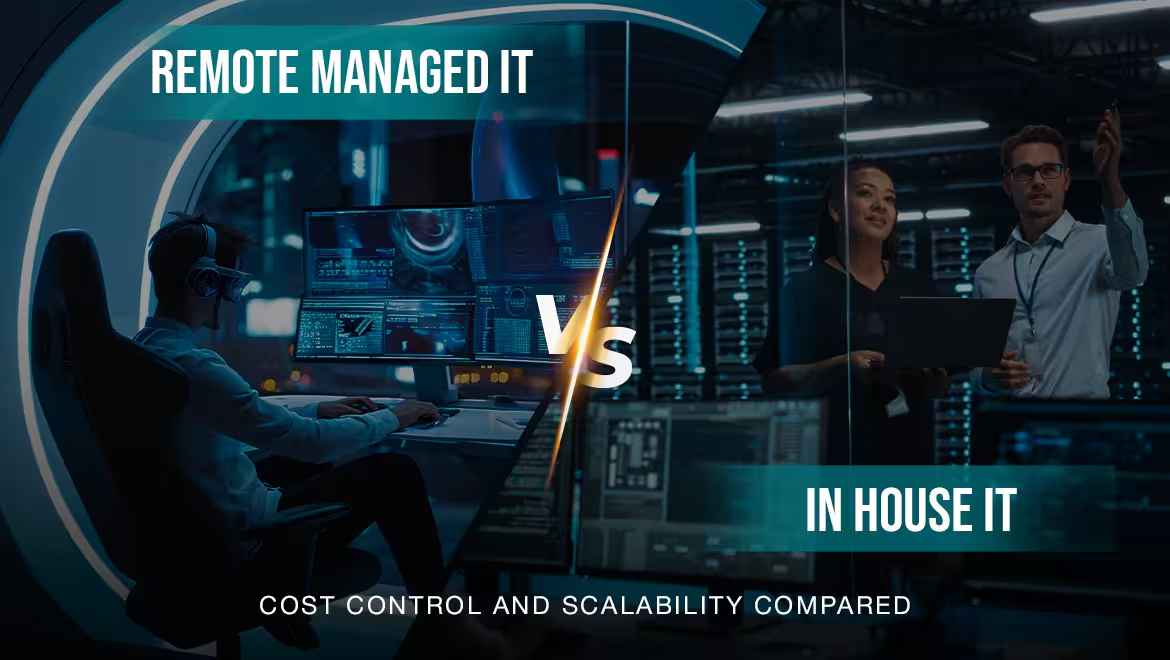
Remote Managed IT vs In House IT Cost Control and Scalability Compared
Modern enterprises in the United States are under constant pressure to keep systems reliable, secure, and cost efficient. The decision between building an internal IT team or adopting remote managed IT services is no longer only technical. It directly impacts financial performance, operational agility, and long term scalability.
Organizations that treat IT as a strategic function rather than a support function tend to evaluate Total Cost of Ownership along with operational trade offs. This comparison helps decision makers understand where managed IT support creates measurable business value.
Understanding Total Cost of Ownership in IT
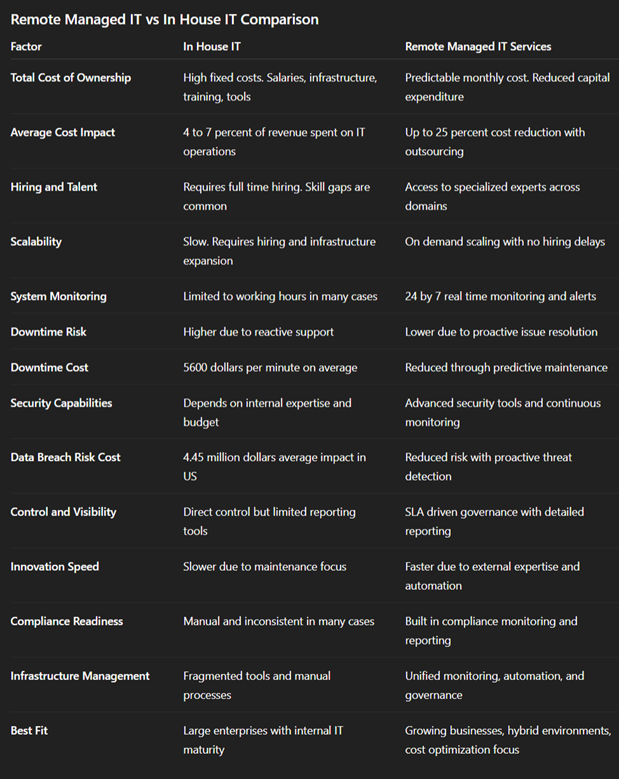
Total Cost of Ownership includes both direct and indirect costs associated with IT operations. In an in house IT model, direct costs include salaries, benefits, infrastructure, licensing, and training. Indirect costs often go unnoticed. These include downtime, productivity loss, delayed upgrades, and security risks.
According to CompTIA, the average mid sized US company spends between 4 percent and 7 percent of its revenue on IT operations. A large portion of this is tied to maintaining internal teams and legacy systems. Additionally, Gartner reports that unplanned downtime costs enterprises an average of 5600 dollars per minute.
Remote managed IT services change this structure. Instead of large upfront investments, organizations shift to a predictable operating expense model. Infrastructure monitoring, security, updates, and support are bundled into a service model. This reduces capital expenditure while improving cost predictability.
Cost Comparison: In House IT vs Managed IT Services
In house IT requires continuous hiring and retention efforts. Skilled IT professionals in the US command high salaries. Cybersecurity specialists, cloud engineers, and DevOps professionals often exceed six figure compensation. Beyond salaries, companies must invest in tools, certifications, and ongoing training.
Managed IT support distributes these costs across multiple clients. This shared expertise model allows businesses to access specialized skills without maintaining a full internal team. A Deloitte study found that organizations using IT outsourcing services reported cost reductions of up to 25 percent while improving service quality.
There is also a hidden cost advantage in proactive management. Remote managed IT service providers in USA detect and resolve issues before they escalate. This reduces downtime and avoids expensive incident recovery.
Control and Governance Considerations
A common concern with outsourcing is loss of control. In house IT provides direct oversight and immediate access to systems and personnel. For organizations with strict internal policies, this can feel more secure.
However, modern IT managed support services operate with defined service level agreements, governance frameworks, and compliance standards. In many cases, managed providers implement stronger monitoring and reporting than internal teams due to their specialized focus.
Security is a critical factor. IBM reports that the average cost of a data breach in the US reached 4.45 million dollars. Managed IT services providers typically deploy advanced threat detection, continuous monitoring, and incident response protocols that many internal teams struggle to maintain due to resource limitations.
Control is no longer about physical proximity. It is about visibility, accountability, and response time. Well structured managed IT support can provide all three with measurable performance metrics.
Scalability and Operational Flexibility
Scalability is where remote managed IT services create a clear advantage. In house IT teams scale slowly. Hiring, onboarding, and infrastructure expansion take time and capital.
In contrast, managed IT services scale on demand. Whether a company is expanding operations, adopting new applications, or handling seasonal spikes, resources can be adjusted without long procurement cycles.
A Flexera report indicates that over 65 percent of enterprises prioritize scalability as a key factor in IT decision-making. Remote managed IT service models align with this need by offering flexible resource allocation and rapid deployment capabilities.
This is particularly relevant for organizations operating in hybrid or multi-location environments. Centralized remote monitoring and management ensure consistent performance across distributed systems.
Operational Trade Offs to Consider
In-house IT offers deep organizational familiarity. Internal teams understand business processes and legacy systems in detail. This can be beneficial for highly customized environments.
However, this familiarity can also lead to inefficiencies. Legacy systems are often maintained longer than necessary due to internal constraints. Innovation slows down when teams are focused on maintenance rather than transformation.
Managed IT services bring external expertise and standardized best practices. This often accelerates modernization and reduces operational complexity. The trade off is the need for clear communication and alignment with business objectives.
Another consideration is response time. While internal teams are physically present, managed providers operate with round-the-clock monitoring. This ensures faster detection and resolution of issues, especially outside business hours.
How Cloud Strategy Complements Managed IT Services
While remote managed IT services improve cost control and operational efficiency, long term scalability depends on how well your cloud infrastructure is designed. Organizations that align managed IT support with a strong cloud foundation achieve better performance, security, and flexibility across their operations.
To understand how cloud services enable secure and scalable enterprise platforms, Read More.
Case Insight: Mid-Sized US Enterprise
A mid-sized healthcare organization in the US transitioned from an in-house IT model to remote managed IT services. The organization faced frequent downtime, compliance challenges, and rising operational costs.
After adopting managed IT support, they implemented real-time monitoring, automated patch management, and centralized governance. Within 12 months, the organization reduced IT operational costs by 22 percent and improved system uptime to over 99.9 percent. Compliance readiness also improved due to consistent monitoring and reporting.
This reflects a broader trend where organizations move from reactive IT management to proactive and predictive operations.
Where Remote Managed IT Services Fit Best
Remote managed IT services are particularly effective for organizations that require high availability, a strong security posture, and scalable infrastructure without heavy capital investment. Industries such as healthcare, finance, and insurance benefit from continuous monitoring and compliance support.
Businesses that are growing or undergoing digital transformation also find value in the flexibility and expertise offered by managed IT support providers USA.
Aryabh Consulting Approach to Remote Managed IT
Aryabh Consulting delivers remote managed IT services designed for reliability, scalability, and operational efficiency. The approach focuses on continuous monitoring, automation, and proactive management of IT infrastructure.
By integrating real-time system monitoring with System workflow automation, Aryabh Consulting Inc. helps organizations reduce operational complexity and improve performance. The model supports hybrid and complex IT environments while maintaining strong governance and security standards.
Organizations benefit from a unified framework that combines provisioning, monitoring, and compliance management. This enables consistent performance and cost optimization without the need for onsite management.
With remote managed IT support for businesses in the USA, Aryabh Consulting ensures that IT infrastructure evolves with business needs. The focus remains on turning IT from a cost center into a strategic asset that supports growth and resilience.