The Rise of Telemedicine Platforms The Rise of Telemedicine Platforms
Healthcare IT & Digital Transformation
  • By ACI
  • 05 March, 2026
  • 7 min Read

HIPAA-Compliant Healthcare Software Development: Security Architecture Beyond Checklists

Healthcare executives and insurers understand that HIPAA compliance goes far beyond documentation. It is about protecting patient trust, preventing costly breaches, and ensuring that healthcare technology systems can withstand both regulatory scrutiny and modern cyber threats.

Healthcare organizations today operate in an environment where clinical systems, cloud infrastructure, and third-party integrations constantly exchange sensitive patient data. In this landscape, compliance must be built directly into the technology infrastructure.

Aryabh Consulting approaches this challenge through architecture-driven Healthcare IT Solutions USA, where security controls are embedded into the engineering foundation of the software itself. Encryption frameworks, role-based access controls, audit integrity systems, zero-trust security models, and intelligent automation work together to create resilient healthcare platforms.

Security practices are integrated across the entire development lifecycle, including threat modeling, secure coding standards, rigorous testing, and controlled deployment pipelines. This approach ensures that compliance is maintained from system design through production deployment.

Compliance Requires Architecture, Not Just Policy

HIPAA defines the regulatory standards for protecting electronic protected health information (ePHI). However, the effectiveness of those rules depends largely on how healthcare systems are engineered.

Healthcare data breaches are expected to cost organizations an average of $7.42 million per incident in 2025, including legal costs, recovery expenses, and regulatory penalties.

Documentation alone cannot prevent these losses. Effective healthcare technology infrastructure depends on technical safeguards such as strong encryption, strict identity management, continuous monitoring, tamper-resistant logging, and secure interoperability across systems.

Organizations increasingly recognize that Healthcare IT Solutions USA providers must engineer compliance into system architecture rather than attempting to retrofit security during audits.

Building Secure Architecture Before Development Begins

Many security incidents originate from poorly designed legacy systems. Research shows more than 80% of healthcare breaches involve configuration weaknesses or outdated infrastructure.

For this reason, Aryabh Consulting begins projects with a structured security and healthcare consulting assessment. The process evaluates several critical areas:

  • Data flow pathways across applications
  • Integration dependencies between systems
  • Identity and access management gaps
  • Regulatory exposure points
  • Infrastructure risk factors

Understanding these elements early ensures healthcare IT systems are designed with security controls embedded at every layer.

Encryption as the Foundation of Healthcare Data Protection

Encryption remains one of the most effective defenses against unauthorized access to patient data. Yet misconfigured encryption continues to cause significant security incidents. In 2024, nearly 65% of hospital data breaches were linked to weak or improperly implemented encryption controls.

Modern healthcare platforms protect sensitive information using enterprise-grade encryption frameworks. These typically combine AES-256 encryption for data at rest with TLS 1.2+ protocols for secure transmission across networks.

Encryption keys are managed through hardened key-management systems that control lifecycle access and prevent unauthorized retrieval. Together, these measures form the foundation of secure healthcare data infrastructure.

Managing Access and Reducing Insider Risk

Data security is not limited to defending against external attacks. Internal misuse of information remains a persistent concern across healthcare organizations.

Studies estimate that approximately 10% of healthcare breaches originate from individuals inside the organization.

To reduce this risk, Aryabh Consulting applies Role-Based Access Control (RBAC) within enterprise healthcare platforms. Access privileges are aligned with job responsibilities so users can only view or modify the information necessary for their work.

Additional governance controls include privileged access monitoring, segregation of duties for sensitive operations, automated user provisioning, and multi-factor authentication. These mechanisms strengthen healthcare data security while supporting regulatory compliance requirements.

Audit Integrity and Tamper-Resistant Logging

Healthcare organizations must maintain accurate records of system activity for regulatory reviews and incident investigations.

Advanced healthcare IT systems therefore implement tamper-resistant audit logs that capture authentication events, data access activity, configuration changes, and security alerts. Because these records cannot be altered without detection, they provide reliable evidence during compliance audits.

To further strengthen audit integrity, Aryabh Consulting Inc. applies blockchain-inspired verification techniques. These mechanisms create tamper-evident records that help validate log authenticity and maintain a transparent security history across enterprise healthcare environments.
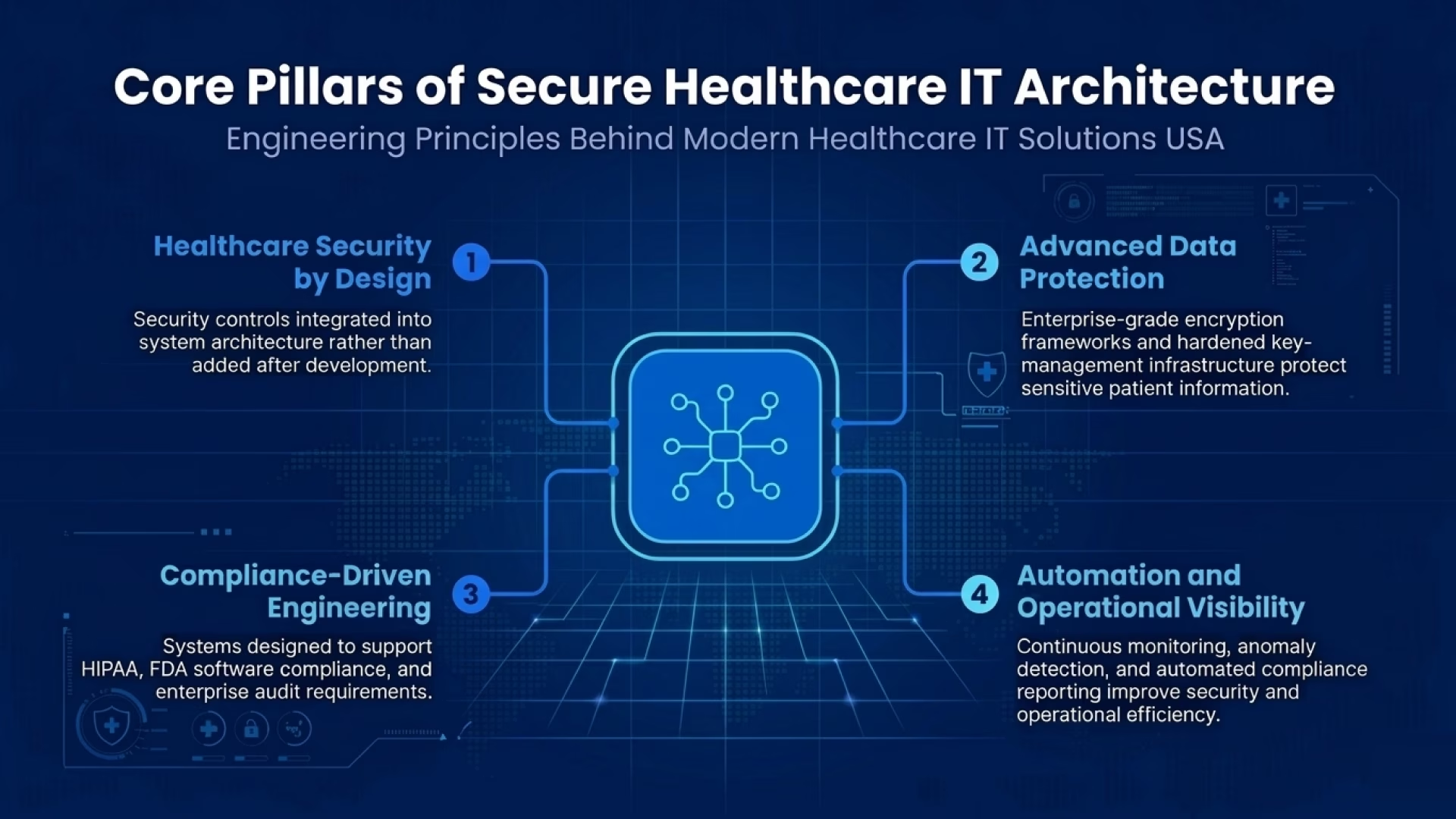
HIPAA compliant healthcare IT architecture framework used in Healthcare IT Solutions USA

Zero-Trust Security for Modern Healthcare Networks

Custom software development comes with real benefits but also challenges every business should weigh before making the investment.

Healthcare networks have expanded rapidly with cloud infrastructure, remote clinical access, and third-party data integrations. In this environment, traditional perimeter-based security models are no longer sufficient.

By 2025, nearly 75% of healthcare cyberattacks bypassed traditional network defenses, highlighting the need for stronger security frameworks.

Zero-trust architecture addresses this challenge by requiring verification of every user and device attempting to access the system. Within modern Healthcare IT Solutions USA, this model includes strict identity validation, continuous user behavior monitoring, network segmentation, and controls that prevent lateral threat movement.

These safeguards are particularly valuable for healthcare organizations operating hybrid cloud and multi-facility environments.

Automation Strengthens Operational Security

Healthcare IT environments generate enormous volumes of operational data, making manual monitoring inefficient and error-prone.

Research indicates that manual compliance processes contribute to nearly 30% of operational delays in healthcare IT operations.

To address this challenge, Aryabh Consulting integrates Python-based automation frameworks into secure healthcare platforms. These systems monitor logs continuously, detect anomalies, trigger alerts, and generate audit-ready compliance reports.

Automation allows healthcare organizations to maintain real-time visibility into system activity while reducing administrative overhead.

Secure Interoperability and EHR Integration

Modern healthcare delivery depends on reliable information exchange between hospitals, laboratories, insurers, and care providers.

However, interoperability failures contributed to approximately 25% of HIPAA penalties in 2024, often due to insecure integrations or weak access controls.

Aryabh Consulting addresses these challenges through secure EHR integration frameworks that support standards such as HL7 and FHIR. Secure API gateways, encrypted data pipelines, and structured permission layers help ensure patient information can move safely between systems.

These capabilities are a critical component of modern Healthcare IT Solutions USA, where data sharing must occur without compromising privacy or regulatory compliance.

Building Resilient Healthcare Technology Platforms

Healthcare organizations require technology partners who understand regulatory complexity, cybersecurity threats, and the operational demands of large clinical systems.

Through architecture-driven Healthcare IT Solutions USA, Aryabh Consulting develops enterprise healthcare platforms that combine secure infrastructure, interoperability frameworks, and compliance automation.

For healthcare executives and insurers, sustainable compliance depends on systems engineered for security from the beginning. This engineering-first approach helps organizations protect patient data while maintaining reliable and efficient healthcare operations.

Frequently Asked Questions

1. How does Aryabh Consulting go beyond basic HIPAA compliance??

We use encryption, role-based access, zero-trust architecture, immutable audit logs, and automation directly in the system design. Compliance is built into the foundation.

2. Do you use blockchain in healthcare security?

Yes. We apply blockchain-backed concepts to strengthen the audit trail integrity and avoid the unauthorized modification of the access records.

3. How do you automate security monitoring?

We use Python-based automation to monitor logs, detect anomalies, get alerts, and produce compliance reports in real time.

4. Can you support large hospital networks and insurers?

Yes. Our EHR solutions for healthcare enterprises and Healthcare IT solutions USA are designed for multi-facility health systems and insurers.

5. How do you ensure secure interoperability across systems?

We use encrypted APIs, healthcare interoperability standards, role-based permissions, and secure EHR integration frameworks to protect the data during the exchanges.
This article is intended solely as a technical overview based on our insights and understanding of current technology trends. It does not promote, endorse, or represent any specific company, product, or individual. The content is purely informational and reflects our independent perspective on the subject.
1

Related Blogs

Revolutionize Care with Telemedicine
Healthcare IT & Digital Transformation

Revolutionize Care with Telemedicine

By Admin 7 min Read

In an era where digital-first solutions are reshaping the healthcare landscape, telemedicine has emerged as a vital pillar of modern care delivery. No longer confined to emergency measures or rural outreach, virtual healthcare is now a mainstream expectation—driven by changing patient behavior, technology innovations, and regulatory shifts. For healthcare providers across the United States, the question is no longer if they should adopt telemedicine, but how to do it right—safely, strategically, and at scale. At Aryabh Consulting, we specialize in delivering healthcare-specific IT solutions that include user-centric telemedicine platforms, remote IT infrastructure management,  software integration , and compliance-first system design —all tailored to the evolving needs of medical organizations. The Rise of Telemedicine: What’s Driving the Surge? Telemedicine isn’t just a temporary trend—it’s a fundamental transformation. Here’s what’s fueling its unprecedented growth: COVID-19 as a Catalyst The global pandemic fast-tracked the adoption of remote care. Healthcare providers turned to telemedicine to: Maintain care continuity while reducing exposure risk Treat non-emergency cases outside hospital settings Ensure chronic disease management during lockdowns According to McKinsey, telehealth usage was 38 times higher in 2021 than before the pandemic. Shift in Patient Expectations Today’s patients are digitally literate and demand: On-demand consultations Flexible appointment scheduling Access to care from home, work, or on the move Convenience is now a competitive differentiator. Maturity of Digital Tools Tech advancements have made virtual care viable and efficient: Secure, high-quality video conferencing Real-time health data sharing via wearables Cloud-based EHR systems with remote access Government & Insurance Backing Policymakers and payers have aligned to support telehealth: Relaxed state licensure laws for cross-border care Expanded Medicare and Medicaid reimbursement Looser restrictions under HIPAA during public emergencies These trends are unlikely to reverse—telemedicine is here to stay. Building a Sustainable Telemedicine Ecosystem: What Providers Must Know Implementing telemedicine goes beyond simply installing a video call function. It requires thoughtful planning, secure infrastructure, and end-to-end integration to truly succeed. Let’s break down the key areas that healthcare providers need to focus on: 1. Data Privacy, Security & HIPAA Compliance Data security is non-negotiable in healthcare IT. With rising cyber threats and stricter enforcement of HIPAA rules, providers must ensure: End-to-end encryption for all video and messaging tools Secure cloud storage with multi-factor authentication Role-based access controls to restrict sensitive data access Comprehensive audit trails for every patient interaction A data breach costs healthcare organizations $10.93 million per incident on average (IBM, 2023). How Aryabh Helps: Our platforms are built with HIPAA compliance baked in—every feature, integration, and access point meets rigorous data governance standards. 2. Integration with Existing Workflows and Systems For telemedicine to feel seamless, it must integrate with your current tools and processes: Electronic Health Records (EHR) systems like Epic, Cerner, or AthenaHealth Billing platforms for insurance claims and co-pay processing Patient scheduling systems with real-time appointment syncing Clinical documentation and note-taking tools This integration ensures efficiency, reduces administrative burden, and prevents medical errors. 3. User Experience (UX) That Builds Trust Your telemedicine platform must be intuitive and responsive for both providers and patients. No complex logins or downloads Mobile optimization for Android/iOS Clear video/audio quality on all devices Real-time status updates and appointment reminders Accessible UI/UX for elderly or non-tech-savvy users Studies show that 40% of patients won’t return to a telehealth provider after a poor experience. Aryabh’s Approach: We design human-centric platforms that prioritize clarity, speed, and simplicity across all devices. 4. Scalability with Remote Support Your telemedicine infrastructure should scale with patient volume and operational growth. You’ll need: Cloud architecture for flexibility and uptime Load balancing and redundancy for large-scale operations 24/7 remote monitoring and incident response Whether you’re a solo practice or a hospital network, telemedicine growth should not create IT bottlenecks. With Aryabh’s Remote IT Services, we proactively manage system uptime, performance, and tech support—so you can focus on care. 5. Customization for Your Organization’s Unique Needs Generic, off-the-shelf solutions often lack the adaptability needed for specialized care. Healthcare organizations differ in: Clinical workflows Branding and patient engagement strategies Specialties (e.g., psychiatry vs. pediatrics vs. orthopedics) Our user-centric solutions include: White-labeled platforms matching your branding Role-specific dashboards for different staff levels Flexible modules for intake forms, video consults, e-prescriptions, and follow-ups With Aryabh’s Remote IT Services, we proactively manage system uptime, performance, and tech support—so you can focus on care. Strategic Takeaways for Healthcare Leaders To thrive in the era of virtual care, healthcare organizations should: Prioritize regulatory compliance and cybersecurity Integrate telemedicine with core systems, not bolt it on Design for user-friendliness across patient demographics Build a scalable tech stack that grows with demand Partner with experienced IT consultants who understand healthcare These trends are unlikely to reverse—telemedicine is here to stay. Ready to Modernize Your Healthcare Services? At Aryabh Consulting, we help healthcare providers build the future of care delivery. Our user-centric healthcare solutions, remote IT infrastructure services, and software integration expertise ensure your telemedicine platform is secure, efficient, and scalable. Let's build a healthcare system that works smarter. Contact Aryabh Consulting today to explore user-centric solutions made for your success. We love to hear from you Contact Us

The Role of Interoperability in Modern Healthcare Systems
Healthcare IT & Digital Transformation

The Role of Interoperability in Modern Healthcare Systems

By Admin 4 min Read

In today’s healthcare landscape, data is the lifeblood of effective patient care. But when systems don’t talk to each other, that lifeblood becomes fragmented—resulting in delays, redundancies, and costly inefficiencies. That’s where interoperability steps in. Interoperability is no longer just a tech buzzword—it’s a critical enabler of connected, coordinated, and patient-centric care. By ensuring that different health IT systems can exchange, interpret, and use data consistently, interoperability is transforming healthcare delivery across the globe. What is Healthcare Interoperability? At its core, interoperability is the ability of different health information systems, devices, and applications to access, exchange, integrate, and cooperatively use data in a coordinated manner. This applies across: This approach has become popular due to: Electronic Health Records (EHRs) Medical imaging platforms Lab systems Pharmacy systems Wearables and remote patient monitoring devices Whether it’s a hospital in Boston or a clinic in Bangalore, interoperability ensures seamless communication between disparate systems, improving both efficiency and clinical outcomes. Why Interoperability Matters Now More Than Ever With the growing adoption of telehealth, AI diagnostics, and patient-facing health apps, data silos are no longer sustainable. Key benefits of interoperability include: Improved Patient Care: Clinicians get a complete picture of patient history, reducing diagnostic errors and redundant testing. Faster Decision-Making: Real-time access to lab results, vitals, and prior treatments supports quicker clinical decisions. Enhanced Data Security & Compliance: Standardized, centralized access reduces unauthorized sharing and supports HIPAA/FDA compliance. Reduced Administrative Burden: Automated data exchange lowers the time spent on manual data entry and paperwork. Real-World Impact: How Interoperability Saves Lives Imagine this: A patient visits the ER unconscious. Without interoperability, doctors may miss a crucial allergy, a chronic illness, or medication history—putting the patient at serious risk. But with an interoperable EHR system, that information is available within seconds, improving the speed and accuracy of care. Key Standards Driving Interoperability Several global standards support seamless healthcare data exchange: HL7 (Health Level 7): A framework for the exchange of clinical data. FHIR (Fast Healthcare Interoperability Resources): A next-gen standard focused on mobile and cloud applications. DICOM: Standard for medical imaging interoperability. LOINC & SNOMED CT: Terminology standards to unify data representation across systems. Challenges to Achieving Full Interoperability Despite its promise, achieving true interoperability comes with obstacles: Legacy systems with incompatible formats Lack of universal adoption of data standards Privacy, consent, and security concerns High integration costs for small providers The Future: Interoperability Meets Innovation As healthcare continues to shift toward value-based care and personalized medicine, interoperability will serve as the foundation for: Cloud infrastructure management: Predictive analytics using cross-platform data Coordinated care across specialists, insurers, and pharmacies AI-driven diagnostics and remote monitoring solutions Patient-owned health records and improved engagement Conclusion Healthcare is evolving rapidly—and interoperability is the glue holding this transformation together. By enabling seamless data exchange, healthcare systems not only improve patient outcomes but also build trust, efficiency, and resilience in the face of tomorrow’s challenges. Organizations that embrace interoperability now are setting the stage for smarter, safer, and more connected care. We love to hear from you Contact Us

EHR vs EMR: Which Should Healthcare Providers Choose?
Healthcare IT & Digital Transformation

EHR vs EMR: Which Should Healthcare Providers Choose?

By ACI 6 min Read

Healthcare providers face growing pressure to modernize patient care while maintaining compliance and data security. Choosing the right electronic healthcare management suite is critical. Electronic Health Records (EHR) and Electronic Medical Records (EMR) are often confused, yet they serve different purposes. Understanding their differences, benefits, limitations, and integration requirements helps administrators and IT managers make informed decisions. Defining EMR and EHR EMR is a digital version of a patient’s chart. It stores medical history, diagnoses, medications, and lab results. EMRs are primarily used within a single healthcare organization. EHR is more comprehensive. It shares patient information across multiple healthcare settings. EHR includes all EMR data but also supports coordination between specialists, hospitals, and laboratories. Feature EMR EHR Scope Single clinic or practice Multiple providers and settings Data Sharing Limited Extensive, supports interoperability Patient Access Usually no Often allows patient portal access Compliance Focus Internal HIPAA compliance HIPAA compliance across systems and data exchange Reporting & Analytics Basic Advanced, population health insights Benefits and Limitations EMR Benefits Fast and familiar for small practices. Simple implementation with low upfront cost. Useful for internal clinical tracking. EMR Limitations Limited interoperability. Cannot easily share patient data outside the organization. Less effective for population health management. EHR Benefits Supports seamless patient care across multiple providers. Enables advanced analytics and reporting. Improves patient engagement through portals and remote monitoring. EHR Limitations Higher implementation cost and complexity. Requires staff training and workflow adjustments. Integration with legacy systems can be challenging. Integration and Interoperability Integration is a key consideration for 2025 healthcare providers. EHR systems must connect with existing EMRs, lab systems, imaging software, and pharmacy databases. Real-world challenges include: Legacy systems that use outdated formats. Data migration errors causing incomplete or duplicate records. Interoperability gaps when systems do not follow HL7 or FHIR standards. Successful integration requires careful planning. Hospitals often implement phased migration and continuous testing. Automated validation scripts can reduce errors. Cloud-based EHRs provide better scalability and remote access. Aryabh Consulting helps healthcare organizations integrate EHRs & EMRs while maintaining HIPAA-compliant workflows. This ensures data integrity, operational efficiency, and regulatory adherence. HIPAA Compliance and Data Security Both EMRs and EHRs must comply with HIPAA. Key differences arise in scope and complexity: EMRs focus on internal security. EHRs require secure data exchange across multiple systems. Security strategies include: Encryption for stored and transmitted data. Role-based access controls to limit who can view sensitive information. Audit trails to monitor access and changes. Regular updates and vulnerability testing to prevent breaches. Emerging technologies like blockchain and AI-assisted monitoring enhance compliance and security by providing immutable records and detecting unusual access patterns automatically. Choosing the Right System in 2025 Healthcare administrators should consider: Size and scope of the organization. Small clinics may rely on EMR. Large hospitals or networks benefit from EHR. Integration needs. Evaluate current software and data formats. Patient engagement goals. EHRs support portals and telehealth better. Budget and resources. EHRs require higher upfront investment and staff training. Compliance strategy. Ensure the system can meet HIPAA requirements across all operations. A stepwise approach is recommended: assess current capabilities, define data exchange requirements, select a compliant system, and plan for phased integration. Aryabh Consulting offers guidance and technical support to streamline this process without compromising compliance or patient care. Common FAQs about EMR and EHR 1. What is the main difference between EMR and EHR? EMR is a digital record used within a single clinic or hospital. EHR includes all EMR data but can be shared across multiple healthcare organizations. 2. Which system is better for large hospitals? EHR, as it allows seamless data sharing, advanced reporting, and patient engagement across facilities. 3. How does EHR integration impact HIPAA compliance? EHR integration requires secure data exchange. Compliance depends on encryption, access controls, and audit trails. 4. Can EMR data be migrated to EHR? Yes, with phased migration, validation tools, and staff training to ensure smooth transition. 5. What are common challenges in EHR adoption? Legacy systems, staff training, external integration, and maintaining compliance. 6. How do EHRs improve patient care? By providing a complete medical history across facilities, reducing duplicate tests, and supporting remote care. 7. Are cloud-based EHRs secure? Yes, if implemented with encryption, access controls, updates, and monitoring. 8. How much does EHR cost compared to EMR? EHR has higher implementation costs due to broader features, while EMR is simpler and cheaper for small practices. Conclusion EMR and EHR serve different but complementary purposes. EMR is ideal for internal record management. EHR supports broader data sharing, analytics, and patient engagement. Choosing the right system requires careful assessment of organizational needs, technical readiness, and compliance obligations. Proper integration and security planning ensure a smooth transition and long-term benefits. Investing in the right system improves patient care, enhances operational efficiency, and ensures compliance in 2025 and beyond. We love to hear from you Contact Us