- By Admin
- 17 September, 2026
- 8 min Read
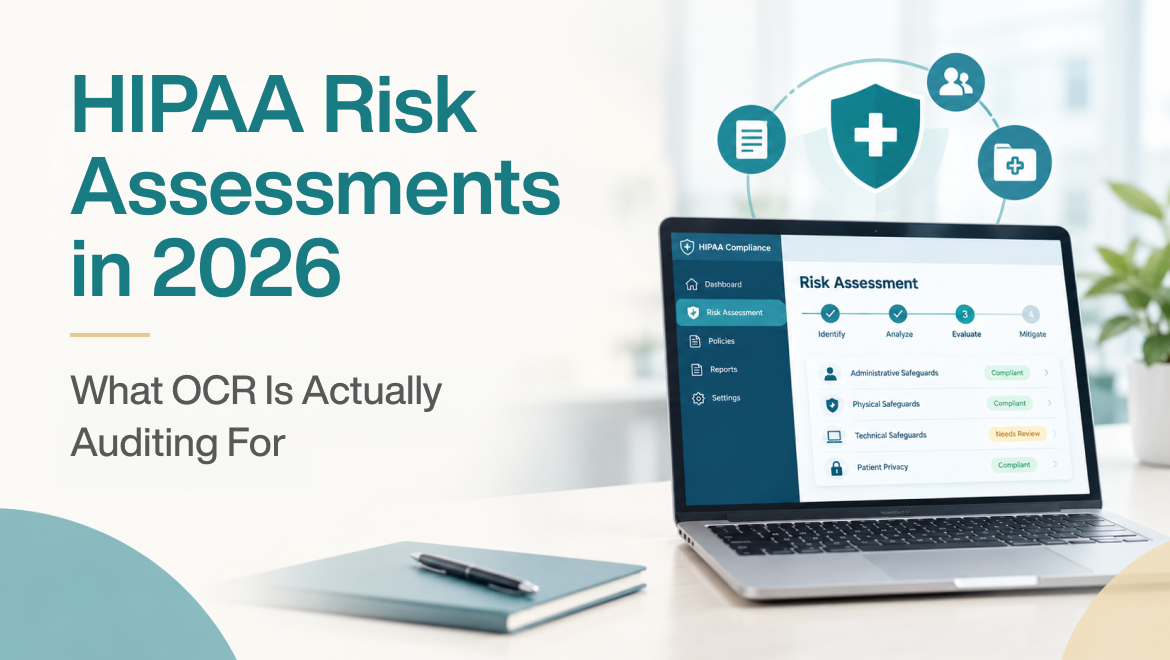
HIPAA Risk Assessments in 2026. What OCR Is Actually Auditing For
For years, a HIPAA risk assessment was treated like a form to file away. Do it once, keep the PDF, and move on. That approach is now a liability. OCR's third phase of HIPAA compliance audits is already underway, and enforcement patterns from 2024 through 2026 show a clear shift. Risk analysis remains the single most cited deficiency in OCR investigations, and the bar for what counts as "accurate and thorough" has gone up.
If your organization handles ePHI in any form, from an EHR to a claims management system to a connected medical device, this is the year to take a hard look at how your risk assessment actually holds up.
Key 2026 Compliance Shifts
The proposed 2026 Security Rule update has not been finalized. OCR is still enforcing the current security rule, but the direction is obvious even without a final rule in place. Three things have changed in practice.
Scope is now explicit. A risk analysis that only covers your primary EHR no longer satisfies the rule. It needs to account for cloud systems, mobile devices, contractor laptops, connected medical device software, and every third-party integration that touches ePHI.
Methodology has to be documented, not just the output. OCR wants to see how you identified threats, how you scored likelihood and impact, and why a given risk was rated medium instead of high. A risk register with no explanation behind it reads as guesswork.
Asset inventory is now treated as a prerequisite. You cannot analyze risk to systems you have not listed. OCR expects a current inventory of everything that creates, stores, or transmits ePHI before it will accept the analysis built on top of it.
Alongside this, the modernization of 42 CFR Part 2 is pulling substance use disorder confidentiality rules closer to HIPAA, which means consent workflows, EHR tagging, and business associate agreements need another look if your organization touches SUD data.
What OCR Is Targeting in 2026 Audits
Enforcement data from recent settlements points to a fairly consistent list of pressure points.
Risk analysis and risk management sit at the top. OCR is not just asking whether you did an assessment. It wants proof you acted on what the assessment found, with owners and timelines attached to each remediation item.
Ransomware readiness and breach response are getting close attention, including how fast notifications go out and whether the content meets the rule's requirements.
Business associate oversight is another recurring theme. Vendors with access to ePHI, including software vendors and IT service providers, are expected to be vetted and monitored, not just signed to a BAA and forgotten.
Rights of access enforcement continues, particularly around how quickly patients get their records and how parental access to minors' records is handled.
Tracking technologies on patient-facing websites and portals are also under review, since improper use of analytics and marketing pixels has triggered breach notifications in past cases.
Core Expectations for an Audit-Ready SRA
An audit-ready security risk assessment in 2026 needs a few things that a bare-minimum version usually skips.
- A current, complete asset inventory covering on-premise systems, cloud infrastructure, remote endpoints, and any medical device software connected to your network.
- A written methodology explaining how risks are identified and scored so the reasoning behind every rating can be defended if OCR asks.
- A risk management plan with assigned owners, deadlines, and a review cadence, not just a list of findings sitting in a spreadsheet.
- Executive sign-off, since OCR increasingly expects leadership to be accountable for risk acceptance decisions, not just IT staff.
- Evidence of an annual update cycle, plus documented triggers for off-cycle reviews after a new system, merger, or security incident.
Essential Steps to Complete Your Assessment
Start by building or refreshing the ePHI asset inventory. Every system, application, and device that touches patient data needs to be on the list, including anything run by a vendor.
Identify threats and vulnerabilities against that inventory, covering technical gaps like unpatched software and firmware, along with process gaps like weak access controls or missing encryption.
Score likelihood and impact using a documented method, and write down the reasoning, not just the final number.
Build a risk management plan that assigns each finding to a specific owner with a real deadline.
Get sign-off from leadership on the analysis and the plan, and keep that documentation on file.
Set a recurring schedule for updates, at minimum annually, with clear triggers for revisiting the analysis sooner.
What Organizations Must Do Now
Waiting for the final security rule before acting is a mistake. Every proposed requirement in the draft rule already reflects current security best practice, so there is little reason to delay. Organizations that put this off until a final rule lands will be working against an implementation timeline that may not be realistic.
Practically, this means auditing your current SRA against the 2026 expectations above, closing the gap on asset inventory and methodology documentation, and making sure your vendor and business associate relationships are actually being monitored rather than just documented once at onboarding.
How Will This Affect Organizations
Small practices feel this differently than large health systems, but nobody is exempt. A small practice using a generic EHR and a handful of vendors still needs a documented inventory and methodology, even if the process is simpler. Larger systems with multiple facilities, integrated claims management systems, and connected medical devices face a heavier lift, since their attack surface and vendor list are both larger.
Software vendors and healthcare IT solutions providers are affected too. If your product touches ePHI, your customers' auditors will eventually ask about your security posture, which puts pressure on vendors to build compliance in from the start rather than bolting it on later.
Where ACI Fits In
This is where Aryabh Consulting Inc. comes in. ACI works with healthcare organizations on healthcare software development that treats HIPAA compliance as part of the build, not an afterthought. That includes EHR and EMR integrated solutions, HIPAA-compliant claims management system builds, and healthcare IT solutions designed around how a practice actually documents care and processes claims, rather than a generic off-the-shelf template.
For organizations working with connected medical device software or agentic automation, ACI builds with role-based access, encryption, and audit logging from the ground up, so the systems feeding your risk assessment are defensible rather than a liability sitting inside it. As one of the Healthcare Software Development Companies in USA that works directly with practices on their coding, claims, and EMR workflows, ACI can help you look at where your current systems create audit exposure and what a properly integrated build would fix.
Frequently Asked Questions
What is an OCR audit?
An OCR audit is a review conducted by HHS's Office for Civil Rights to check whether a covered entity or
business associate is meeting HIPAA requirements. It typically examines risk analysis, risk management,
breach notification practices, and safeguards around ePHI.
What are the HIPAA updates for 2026?
The main update is a proposed security rule revision that adds more specific, prescriptive requirements
around risk analysis, asset inventory, encryption, and multi-factor authentication. It has not been
finalized, but OCR's current enforcement already reflects this direction. The Part 2 rule aligning
substance use disorder confidentiality with HIPAA is also being phased in through 2026.
What is OCR in relation to HIPAA?
OCR, the Office for Civil Rights within HHS, is the federal agency responsible for enforcing HIPAA. It
investigates complaints, conducts audits, and issues civil monetary penalties for violations.
What is the main goal of OCR audits?
The main goal is to confirm that covered entities and business associates are actually protecting patient
data, not just documenting that they intend to. OCR wants to see risk analysis translated into real, tracked
remediation, not paperwork sitting in a drawer.
Closing Thought
A HIPAA risk assessment in 2026 is not a document you file once a year and forget. It is a living record of what you found, what you fixed, and who owns what comes next. If your current assessment cannot answer those questions clearly, now is the time to fix that, before OCR asks first.